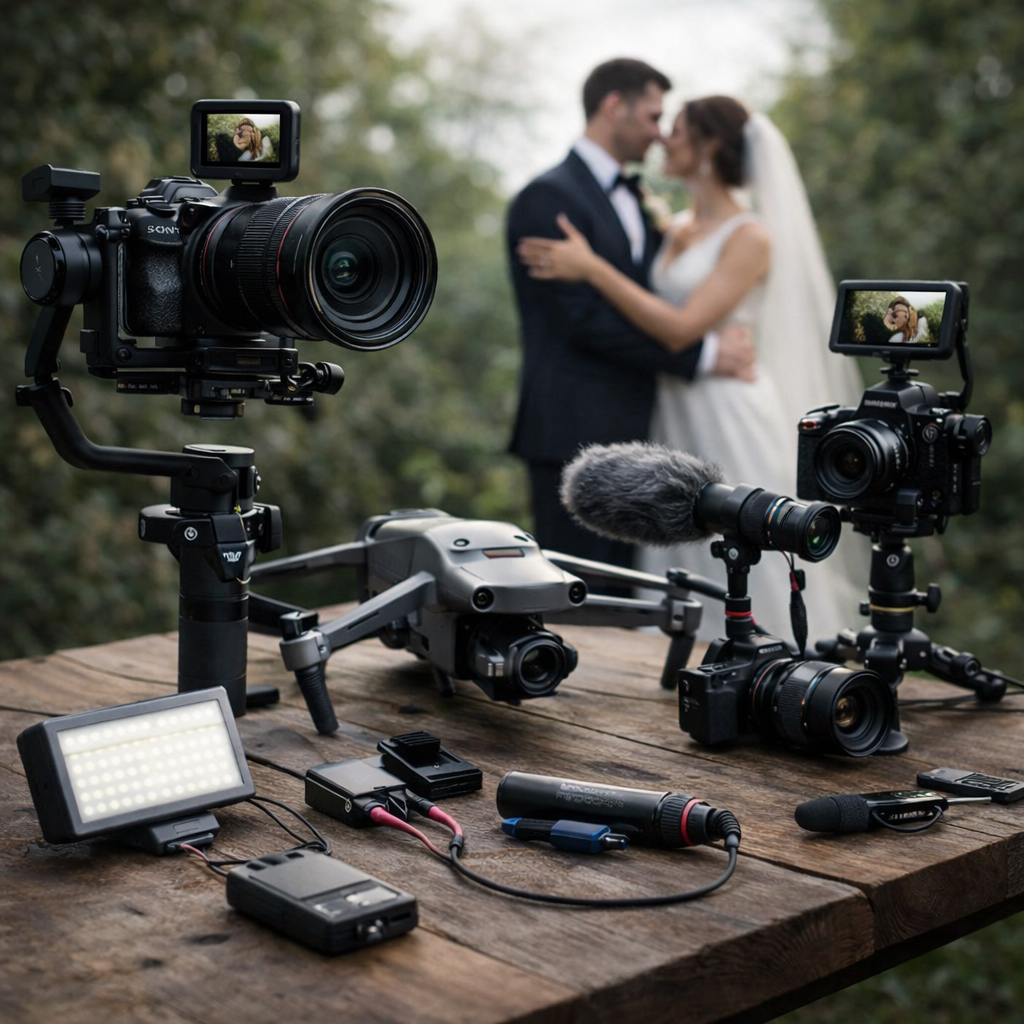
The best tools for wedding videographers in 2026 combine a mirrorless camera (Sony A7 IV, Canon R6 Mark II, or Panasonic S5 II), a fast prime or zoom lens, a gimbal for smooth movement, wireless lavalier mics for clear audio, and subtle LED lighting — all chosen to maximise image quality while keeping your kit light enough to move freely across a full wedding day.
Filming a wedding is one of the most rewarding — and demanding — jobs in video production. Every moment happens once, and there’s no second take. To capture the day beautifully and efficiently, you need the right tools that balance image quality, mobility, and reliability.
Below we’ve rounded up essential gear every modern wedding videographer should consider in 2025.
1. Main Camera: Mirrorless Over DSLR
Mirrorless cameras have become the industry standard for wedding videography. They’re lighter, faster, and produce stunning results.
Top picks:
- Sony A7 IV – excellent autofocus and dynamic range.
- Canon R6 Mark II – reliable skin tones and low-light performance.
- Panasonic S5 II – great color science and stabilization.
Look for a camera that can handle long recording times and has dual card slots for backup.
2. Lenses: Invest in Versatility
A strong lens lineup defines your storytelling.
- 24–70mm f/2.8 for ceremonies and general coverage.
- 50mm f/1.4 or f/1.8 for cinematic portraits.
- 70–200mm f/2.8 for candid moments at a distance.
Fast apertures (f/1.4–f/2.8) help capture soft backgrounds and handle dimly lit venues with ease.
3. Stabilization: Gimbals and Monopods
Smooth movement adds elegance to your footage.
- DJI RS 4 or Zhiyun Weebill 3 provide reliable stabilization without being bulky.
- Combine with a monopod for quick transitions between ceremony and reception.
Handheld movement is great for intimacy, but a gimbal helps when precision and smoothness are key.
4. Audio Gear: Capture the Emotion
Clear audio transforms wedding videos from good to unforgettable.
- Wireless lavalier mics (RØDE Wireless PRO, DJI Mic 2) for vows and speeches.
- Shotgun mic (Deity or Sennheiser MKE 600) for ambient sound.
- Always record backup audio from the DJ’s mixer or a portable recorder.
Audio mistakes can’t be fixed in post — prioritize redundancy.
5. Lighting: Subtle and Natural
Modern wedding films lean toward authenticity. Use lighting that enhances rather than overwhelms.
- Bi-color LED panels (Aputure Amaran, Nanlite Forza) for gentle fill light.
- Compact on-camera LEDs for quick reception setups.
- Always leverage natural light when possible — window light is your best friend.
The best wedding films blend technical mastery with emotional storytelling. Tools can’t replace creativity, but the right setup helps you focus on what truly matters — capturing authentic moments that last a lifetime.
Stay updated, travel light, and never stop experimenting. Each wedding is a new story waiting to be told.
Frequently Asked Questions
What camera is best for wedding videography in 2026?
The Sony A7 IV and Canon R6 Mark II are the top choices for wedding videographers in 2026. Both offer excellent autofocus, strong low-light performance, and dual card slots for in-camera backup — essential when you cannot reshoot a missed moment.
Do I need a gimbal for wedding videography?
A gimbal is strongly recommended for cinematic wedding films. The DJI RS 4 and Zhiyun Weebill 3 provide smooth, professional movement without adding significant weight. Pair it with a monopod for fast transitions between the ceremony and reception.
What microphone should a wedding videographer use?
A wireless lavalier system (RØDE Wireless PRO or DJI Mic 2) clipped to the officiant captures clean vow audio. Always back up with a shotgun mic and a direct feed from the DJ mixer — audio cannot be fixed in post-production.
How much footage does a typical wedding generate?
A cinematic multicam wedding generates 300–500 GB of footage. A documentary single-cam setup typically produces 150–250 GB. Plan your storage and backup strategy before the shoot day.
Should I outsource wedding video editing if I have too much footage?
Yes — if your backlog is growing beyond 3–4 weeks per wedding, outsourcing post-production to a dedicated wedding video editing service frees you to shoot more and protects your delivery timelines. Many videographers outsource the rough cut and colour grade while retaining creative control over the final review.