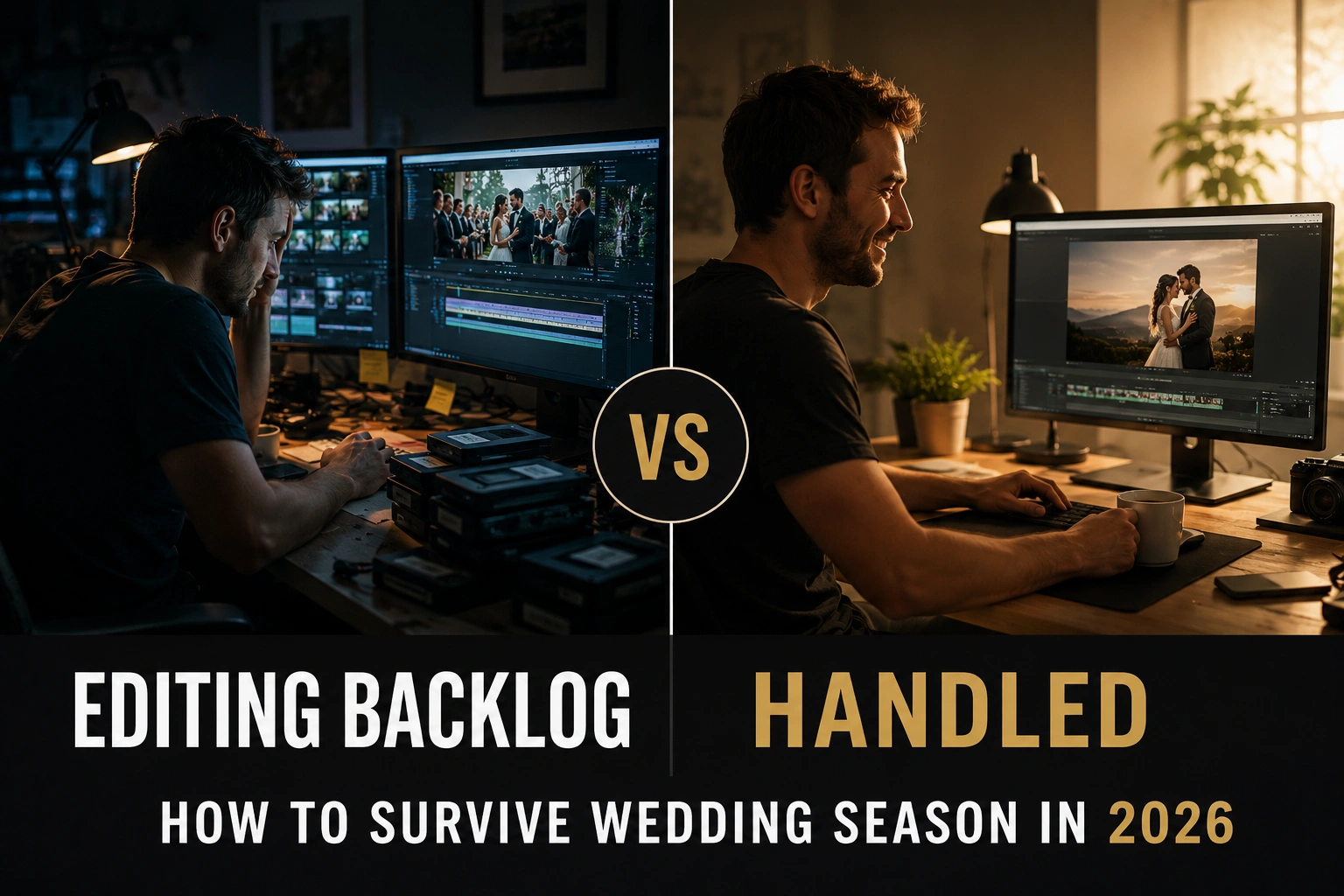
Wedding season backlog happens when bookings outpace your post-production capacity — typically peaking in November after a May–October shoot season. The fix is restructuring, not working harder: edit as you go, build a one-page style guide, and treat outsourced editing as infrastructure rather than a last resort. Videographers who scale past 25–30 weddings a year almost always have a dedicated post-production partner in place before the season starts.
The Backlog Problem Nobody Talks About
You booked a great season. Maybe 20 weddings, maybe 30. Shooting days feel electric — you're in your element, capturing moments that matter. Then September hits. The cameras go down. And you look at your hard drives.
Forty, fifty, sixty hours of raw footage. Each wedding waiting. Each couple checking their inbox. And you, sitting in a dark room, editing the same slow-motion first look for the eighth time this month.
This is the backlog. And it's not a sign that you're bad at your job — it's a sign that your business grew faster than your post-production workflow could keep up with.
Why Wedding Season Creates a Perfect Storm
The math is brutal. A single wedding generates anywhere from 6 to 12 hours of raw footage. A cinematic highlight reel takes 8–15 hours to edit well. A full documentary wedding film? Easily 25–40 hours of post-production. Multiply that by your booking count, and you're looking at hundreds of hours stacked behind a season that's already over.
Meanwhile, your couples are waiting. The average wedding film delivery window in the US market is 8–12 weeks — but when you're buried, it stretches. Four months. Five. Some videographers quietly slip past six. And every week that passes is a week where your couple isn't talking about you to their friends.
The backlog doesn't just cost you sleep. It costs you referrals.
The Burnout Cycle No One Warns You About
Here's what the burnout cycle actually looks like for most wedding videographers:
- Spring bookings come in. You're excited, you say yes to everything. Wedding season starts in May and doesn't stop until October. You tell yourself you'll edit on the slower weeks — but there are no slower weeks.
- By November you're exhausted from shooting and now you have to start editing. You power through the winter.
- By February you've delivered most of it, but you're hollow. You've lost the creative energy that made you good at this in the first place. Then spring comes again. And you do it all over.
The burnout cycle is real, it's common, and it's almost entirely caused by trying to handle every part of wedding video production yourself — from shooting to color grading to final export.
What Videographers Actually Do When They Fix This
The videographers who break the cycle don't work harder — they restructure. Here's what actually works:
- Edit as you go, not all at once. The worst habit in post-production is batching everything to the off-season. Try to deliver each wedding within 3–4 weeks of the shoot date. Yes, this means editing during wedding season. Yes, it's harder in the moment — but it prevents the catastrophic pile-up in November. Even getting through the rough cut while the day is fresh in your memory makes a difference. Your audio-driven storytelling is sharper when you remember how the ceremony actually felt.
- Build a style guide before you hand anything off. The biggest fear about outsourcing your wedding video editing is losing your signature style. This fear is valid — but completely solvable. A style guide doesn't have to be a complex document. Three to five reference films you love. Your preferred color grade — warm, cool, film-style, natural. Your typical pacing and how you handle transitions. Whether you prefer music-driven edits or audio-driven storytelling using vows and speeches. How you approach the highlight reel versus the full wedding film. One document, two pages. Any skilled wedding film editor can work from this and match your creative voice without you micromanaging every cut. The videographers who outsource successfully spend time upfront on the brief — and save hours on revisions.
- Separate what only you can do from what someone else can. Only you can shoot the wedding. Only you can manage the client relationship. Only you can decide the emotional arc of the final film. But the technical assembly — syncing multicam footage, building the rough cut, color grading, audio cleanup, export — these are learnable, repeatable tasks that a professional wedding video editor can handle in your style. Protecting your time for the work only you can do is not laziness. It's strategy.
- Treat outsourcing as capacity, not as compromise. Most videographers think of outsourcing wedding video editing as a last resort — something you do when you're drowning. The videographers who scale past 25–30 weddings a year treat it as infrastructure. They build the relationship with a dedicated editing service in the off-season, run a few test projects, refine the brief, and by the time wedding season hits they have a reliable partner ready to go. The cost of outsourcing one edit is recovered the moment you book one extra wedding with the time you saved.
The Numbers That Make It Simple
Let's say you charge $3,500 per wedding and editing takes you 20 hours per film. At that rate, your editing time is worth $175 per hour in opportunity cost. A professional outsourced wedding video edit runs $280–400 for a cinematic highlight reel. You save 15–18 hours per wedding. That's time you could spend shooting an additional wedding, doing client consultations, or simply not burning out mid-season.
For a videographer shooting 25 weddings a year, outsourcing the post-production work can reclaim 375–450 hours annually. That's not a small number. That's nearly three months of full-time work handed back to you — time you can reinvest in growing your business or getting your life back.
What to Look for in a Wedding Video Editing Service
Not all wedding video editing services are the same. When evaluating a post-production partner, look for these factors:
Dedicated editor, not a rotating team. Style consistency is everything in wedding film editing. You need the same editor on your projects every time — not whoever is available that week. Ask directly: will I have one editor assigned to my account?
NLE compatibility. Make sure the service works in your software. Whether you edit in Adobe Premiere Pro, Final Cut Pro, or DaVinci Resolve, your editing partner should be fluent in the same tools — and ideally deliver project files so you can make final tweaks in-house.
Clear turnaround time. A 5–10 business day turnaround for a cinematic highlight reel is standard for a professional wedding video editing service. If a service promises 48 hours on complex edits without explanation, ask questions. If they're consistently slower than two weeks, your client delivery window suffers.
Structured revision process. Look for timestamped feedback tools like Frame.io rather than email threads. Clear revision rounds with defined scope prevent scope creep and keep projects moving.
Proper onboarding. Any serious wedding film editing service will ask for reference films, your preferred music style, color approach, and delivery specs before touching your footage. If they skip this step, they're guessing at your style — and you'll feel it in the first draft.
White-label delivery. Your clients should never know you outsourced the editing. Professional services deliver finished films that are indistinguishable from your own work — branded to you, not to them.
How to Start Without Disrupting Your Workflow
The best time to start outsourcing is not when you're already overwhelmed — it's during a quieter period when you have time to onboard properly. Here's a simple process:
- Pick one wedding from your backlog — ideally one that's less emotionally complex — and send it to a potential editing partner as a test project. Brief them on your style. Review the first draft with fresh eyes. Give detailed timestamped feedback. See how they respond. If the second draft is close, you've found a partner worth building with. If it's not, you've lost one project's worth of time rather than a full season.
- The videographers who outsource most successfully treat the first two or three projects as onboarding — not as a service transaction. The more clearly you communicate your style upfront, the less correction you'll do later.
This Season, Protect Your Energy
The best wedding films come from videographers who still love what they do. Burnout doesn't just make your life harder — it shows up in the work. The edits get mechanical. The storytelling gets safe. The creative spark that made couples choose you over every other videographer starts to fade.
Fixing your post-production workflow isn't about doing less. It's about staying sharp for the work that actually matters — being fully present on shoot days, connecting with your couples, and crafting films that people will still watch on their tenth anniversary.
The backlog is a solvable problem. You don't have to white-knuckle through another winter alone to prove it.
At FrameFlow Edit, we work exclusively with wedding videographers. We learn your editing style, assign you a dedicated editor, and handle your post-production — highlight reels, full wedding films, documentary edits — so you can focus on shooting and growing your business. Get in touch to start with a free test edit.
Frequently Asked Questions
What causes wedding videographer backlog?
Backlog builds when the volume of weddings shot during the May–October season outpaces editing capacity. Each wedding generates 6–12 hours of footage requiring 8–40 hours of post-production, so even 20 bookings can mean 300+ editing hours stacked behind a single off-season.
How do I catch up on a wedding video backlog fast?
Prioritise oldest weddings first, deliver rough cuts before colour grade to give clients a progress update, and outsource colour grading and assembly edits to a white-label service. Aim to reduce the queue to under 4 weeks behind shoot date.
Is outsourcing wedding video editing worth the cost?
At a typical rate of $280–400 per outsourced highlight reel and 15–18 hours saved per project, the opportunity cost of editing yourself (at $175/hr in booking value) almost always exceeds the outsourcing fee by the time you factor in referrals lost to late delivery.
How do I outsource without losing my editing style?
Create a one-page style guide with colour reference frames, a timestamped pacing example, and a hard-rules list before handing off any footage. A skilled wedding video editor can match your creative voice from this brief without requiring micromanagement on every cut.
When should I start outsourcing wedding video editing?
Ideally in the off-season (January–March), not when you're already drowning. Running one or two test projects before wedding season lets you refine the brief and delivery process so the workflow is ready when bookings peak.