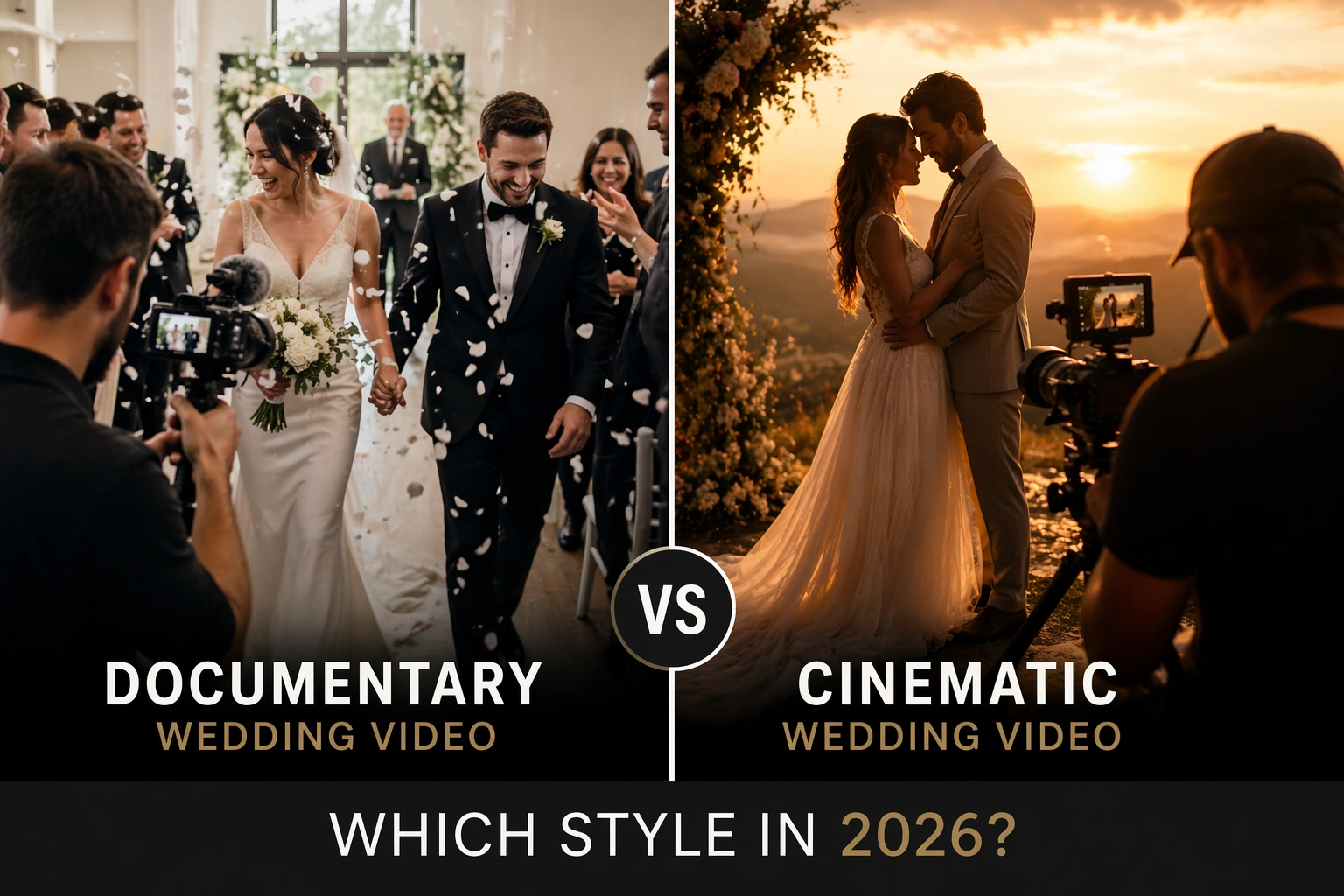
Documentary wedding video captures events as they unfold — chronologically, with available light and minimal direction — prioritising authenticity over visual polish. Cinematic wedding video restructures footage into a crafted narrative, using multicam setups, colour grading, music, and non-linear editing to maximise emotional impact. The right choice depends on your shooting workflow, pricing, and the kind of business you want to build — not just on aesthetics.
Documentary vs Cinematic Wedding Video: Which Style Is Right for You in 2026
It's 11 PM on a Thursday. You're scrubbing through ceremony footage from last weekend, and the bride's walking down the aisle for the fourth time in your timeline. The first take had perfect emotion but shaky framing. The second had locked-off composition but her veil blocked her face. The third had both — but the officiant coughed during the music swell.
You're not editing a wedding video. You're editing a choice you made six months ago when you took the booking: documentary or cinematic.
That choice dictates everything — your shoot day workflow, your gear, your editing hours, your pricing, what clients expect from you, and whether you're spending 20 hours or 40 hours per wedding in post. Most style guides frame this as an aesthetic preference. It's not. It's a business structure decision disguised as a creative one.
Here's what actually separates documentary from cinematic in 2026 — and which workflow matches the kind of videography business you're trying to run.
What Documentary Style Actually Means (Not What Pinterest Says)
Documentary wedding videography is run-and-gun photojournalism applied to video. You capture what happens when it happens. No do-overs, no posed shots, no asking the couple to walk toward the camera slowly one more time with better light.
The wedding day unfolds. You document it.
Real markers of documentary shooting:
- Single-camera or minimal multicam (you + maybe a second shooter)
- Handheld or gimbal-stabilized movement
- Available light — you work with what's there
- Zero direction to the couple (you might redirect guests blocking a shot, but you don't stage moments)
- Audio priority on real vows, speeches, ambient ceremony sound
- Edit structure follows the day chronologically
Documentary doesn't mean low-production-value. It means your creative decision is "what to capture and when", not "how to light and stage it".
Bob Parsons shoots documentary. He's got a Canon C70 on a gimbal, ambient audio from a Zoom recorder clipped to the officiant's lapel, and he's moving through the ceremony to capture angles without ever stopping the action. His final film is 18 minutes of the day in sequence. Tears during the vows, the Best Man forgetting his speech notes, the flower girl refusing to walk the aisle — all in.
That's documentary. It's not B-roll overlaid with music. It's the event.
What Cinematic Style Actually Means (And Why It Takes Longer)
Cinematic wedding videography borrows from narrative film production. You're not just capturing — you're directing. The goal is visual storytelling with high production value, even if that means asking the couple to repeat a moment for the camera.
Real markers of cinematic shooting:
- Multicam setups (3+ angles on ceremony, speeches)
- Glidecam, slider, drone, gimbal moves choreographed in advance
- Lighting control (off-camera LED panels, reflectors, diffusers)
- B-roll sessions with the couple (golden hour portraits, slow-motion walking shots)
- Audio mix includes score, sound design, layered ambient
- Edit structure is non-linear — you're building emotional arcs, not replaying the timeline
Cinematic means you're making a short film about the wedding, not a recording of the wedding.
Lisa Chang shoots cinematic. She's got a Sony FX3 locked on sticks for the ceremony wide, an FX30 on a gimbal for movement, a third cam on the couple's reaction shots. She's placed Aputure MC lights behind the altar for rim lighting. After the ceremony, she takes the couple outside for 20 minutes of slow-motion walking-toward-camera shots during golden hour. Her final film is 8 minutes, non-chronological, cut to a licensed indie track with orchestral builds.
That's cinematic. It's a crafted narrative.
The Workflow Gap Nobody Warns You About
Here's where style choice becomes a business math problem.
Documentary shooting workflow:
- Shoot day: 8–10 hours coverage
- Footage ingested: 150–250 GB (single or dual cam)
- Multicam sync time: minimal or none
- Editing time: 15–20 hours (you're mostly cutting for pacing, not building scenes)
- Color grading: naturalistic correction, faster
- Audio: sync what was recorded live, clean it up, done
Cinematic shooting workflow:
- Shoot day: 8–10 hours coverage + 30–60 min planned B-roll sessions
- Footage ingested: 300–500 GB (multicam + drone + slo-mo)
- Multicam sync time: 4–6 hours (ceremony alone if 3+ cams)
- Editing time: 25–40 hours (you're constructing emotional beats, not trimming a timeline)
- Color grading: stylized look, LUT matching across cams, longer
- Audio: music selection, score editing, sound design layering, dialogue ducking
Cinematic workflows add 10–20 hours *per wedding* in post. That's not a style preference — it's a capacity decision. If you're shooting 25 weddings a season, cinematic adds 250–500 hours of editing labor.
Which is fine if you've priced for it. Most videographers haven't.
Hybrid Isn't a Compromise — It's Two Workflows
Some videographers pitch "hybrid" style: documentary coverage + cinematic editing.
Be honest about what that means. You're shooting documentary (run-and-gun, minimal setup) but editing cinematic (multicam sync if you ran multiple cams, color grading for mood, non-linear structure). You get the time efficiency of documentary shooting but the time cost of cinematic post.
Hybrid works if:
- You're charging cinematic rates ($5K+)
- You've outsourced post or built it into your pricing
- You're clear with clients about deliverable style (not "we do everything")
Hybrid doesn't work if:
- You're trying to deliver cinematic output at documentary pricing
- You're shooting single-cam but promising multicam-quality edits
- You haven't done the turnaround math on 30+ weddings a season
Most "hybrid" videographers are just documentary shooters who color grade more.
The Style You Pick Builds the Business You Get
Documentary or cinematic isn't just a creative preference. It's a declaration of what kind of videography business you're building.
Documentary = higher volume, faster post, repeat client referrals, naturalistic shooting, in-house editing feasible up to 20–25 weddings a season.
Cinematic = lower volume, longer post, Instagram-driven bookings, production-heavy shooting, outsourcing necessary beyond 12–15 weddings a season.
Neither is better. One matches your capacity and pricing structure — or it doesn't.
If you're charging $3,000 per wedding and editing 35 hours per wedding, the problem isn't your style. It's the math. If you're booking 20 weddings a season and delivering films 6 months late, the problem isn't your talent. It's the workflow.
Pick the style that fits the business you can actually operate — then price and staff for it.
Still editing November weddings in April? Your backlog isn't a creative problem. It's a capacity problem. FrameFlow Edit handles post-production for wedding videographers — documentary, cinematic, or hybrid. We match your style, deliver in 12 days, and free you up to shoot the next one. See how we work → frameflowedit.com.
Frequently Asked Questions
What is the difference between documentary and cinematic wedding video?
Documentary wedding video records the day as it happens — candid, chronological, and unscripted. Cinematic wedding video is a directed, non-linear short film built from the footage, with deliberate colour grading, music, and emotional pacing. Documentary typically takes 15–20 hours to edit; cinematic takes 25–40 hours per wedding.
Which wedding video style takes longer to edit?
Cinematic style adds 10–20 hours of post-production per wedding compared to documentary. Multicam sync alone can take 4–6 hours for a three-camera ceremony setup. If you shoot 25 weddings a season, the style difference equals 250–500 additional editing hours annually.
Is cinematic or documentary style better for wedding videographers?
Neither is objectively better — each suits a different business model. Documentary works well for high-volume shooters who prioritise fast turnaround. Cinematic commands higher prices but requires more post-production time or a dedicated editing partner. Many successful videographers offer a hybrid approach.
Can I outsource cinematic wedding video editing?
Yes. Cinematic editing — multicam sync, colour grading, audio layering, and non-linear storytelling — can be delegated to a professional wedding video editing service. Provide a detailed style guide with reference films and your preferred colour palette, and a skilled editor can match your creative voice without you reviewing every cut.
What does a hybrid wedding video style mean?
A hybrid style combines documentary coverage (capturing events as they happen) with cinematic techniques (planned B-roll, styled shots, colour-graded highlights). The result is a film that feels authentic and emotionally crafted — and typically delivers two products: a full documentary cut and a shorter cinematic highlight reel.